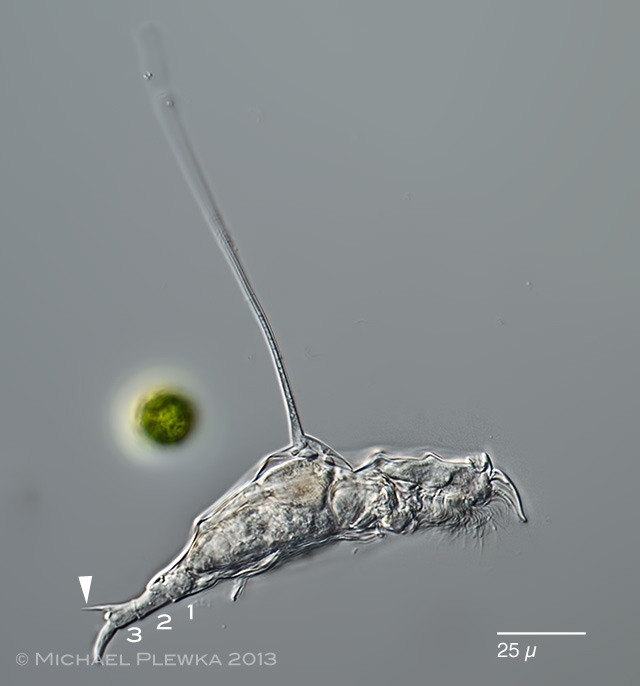
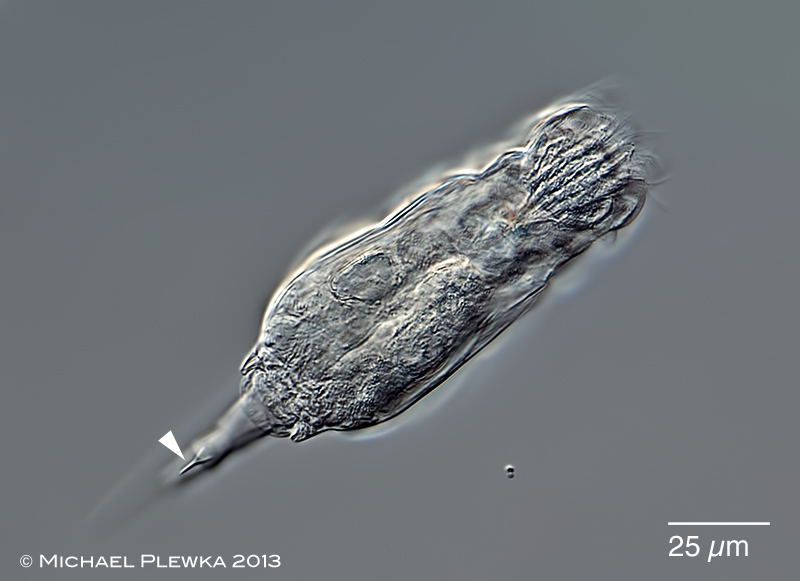
| Squatinella longispinata, formerly erroneously identified as S. leydigi, lateral view; has a conspicuous spine on the back (nat.res. Heiliges Meer; coll. 2.11.2012; img: 19.6.2013). In contrast to S. leydigi S. longispinata has 3 foot segments and a small spine on the top of the 3rd foot segment (arrowhead). I found S. longispinata in three samples from different locations, always associated with the carnivorous bladderwort (Utricularia). |
| This animal is a typical example where one can start speculating about the function of this long spine. One might think of protection against predators, but to my knowledge there aren´t none. I found plenty of these creatures in the "jungle" of a dense Utricularia-thicket where the spine is more obstructive when moving between the plants. Maybe the spine prevents this species from beein trapped in the bladders. The spine can be folded backwards, but there are no big muscles which might cause a beating movement as it is accomplished by Filinia or Monommata. Undoubtedly the spine increases the surface area of the rotifer, but I have no idea what selectional advantage this might be. |
| All of these aforementioned aspects cannot be very significant adaptive advantages, because another member of the genus without this conspicuous spine (S.mutica) was also found among other species in the same samples. |
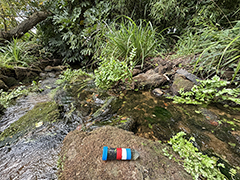
| Also interesting is the new observation (2026) of specimens with such long spines found in lotic water in France (see below). |
| |
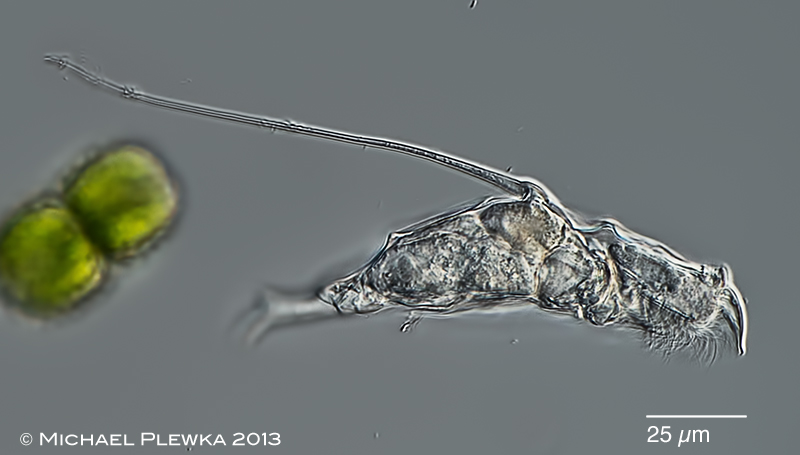 |
| Squatinella longispinata, while swimming the spine is directed backwards. In contrast to Squatinella bifurcata this species has only one single dorsal spine. (2) |
| |
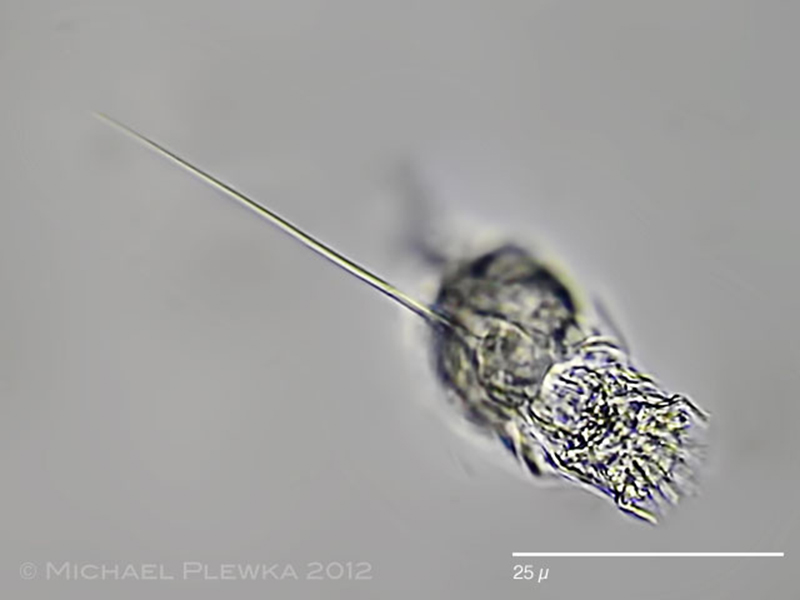 |
| Squatinella longispinata, frontal view, focus plane on the spine on the back. The rostrum on the head is very small. Image from video (1) |
| |
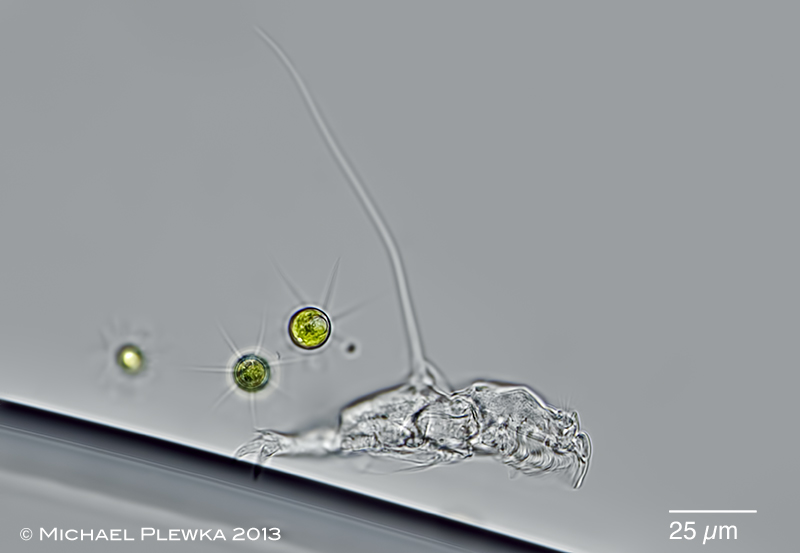 |
| Squatinella longispinata, lateral view of another specimen (3), unfortunately stuck to an air bubble. The green algae are Lagerheimia longiseta. (3) |
| |
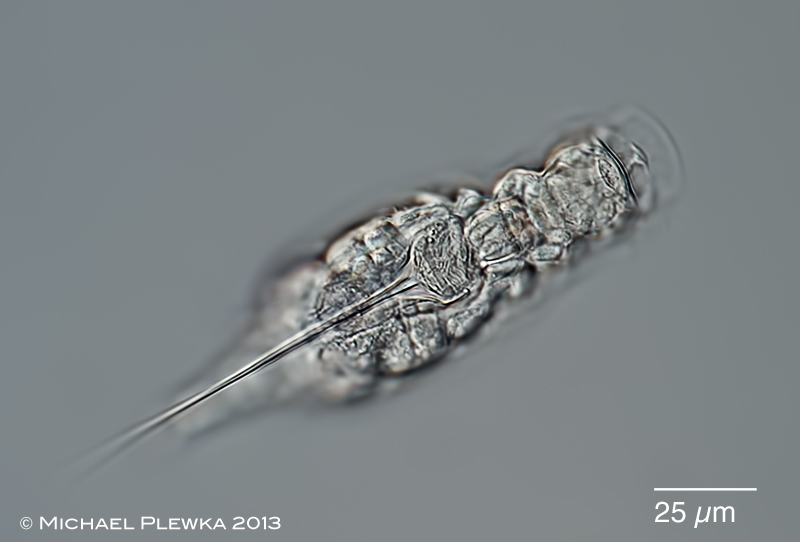 |
| Squatinella longispinata, dorsal view, focus plane on the base of the dorsal spine (3) |
| |
 |
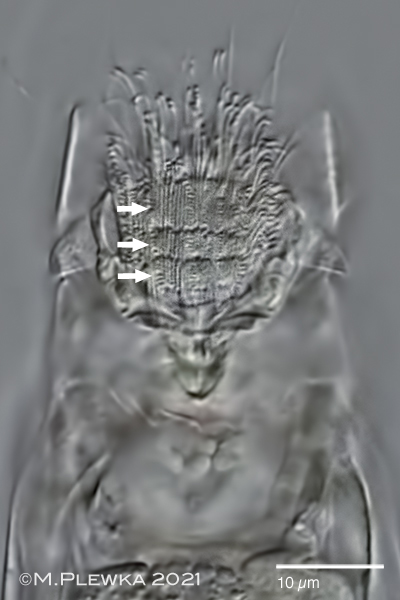
Squatinella longispinata, ventral view, focus plane on the small spine of the 3rd foot segment (arrowhead) and the ventral ciliary field. The cilia are orientated in 3 transversal rows (see images below). (While moving forward the cilia are beating in a strange way: they seem to be beating in transversal direction giving the impression of the movement of the blade of an electric shaver) Due to their fast movement the beating of the cilia has been misinterpreted earlier (sse text in brackets before) Only by a highspeed video with 300 fps it becomes visible that (the effective strokes of) the cilia are beating parallel to the longitudinal axis, so the recovery stroke is directed forwardly, resultung in a metachronal wave that is directed to the right. (3)
See the YT-video here >>> |
| |
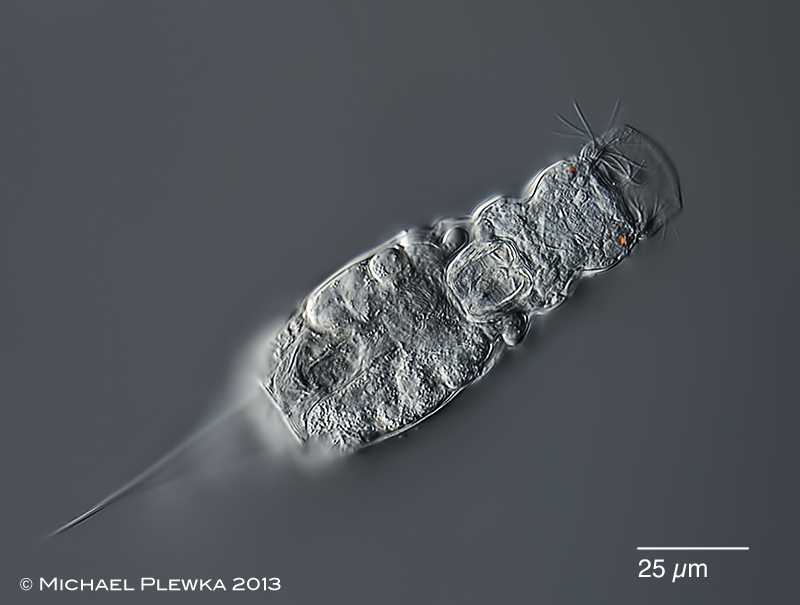 |
| Squatinella longispinata, dorsoventral view, focus plane on the rostrum and the two red eyespots (3) |
|
| |
|
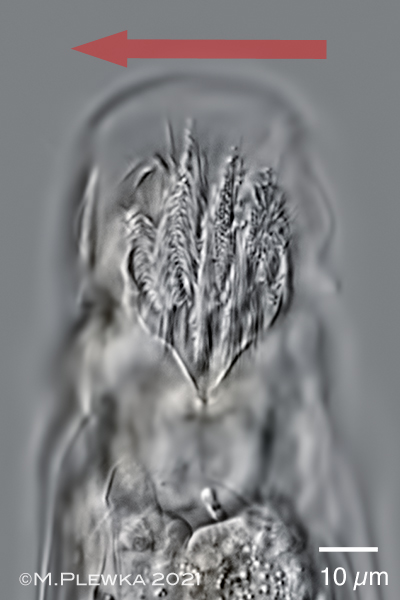
| Squatinella longispinata, two images of the ventral ciliary field; ventral view. Left: focal plane in the base of the cilia. The arrowheads mark three transversal rows of hypodermis cells where the cilia are inserted. The anterior (bent) cilia are in the phase of recovery stroke (which is directed forwards) (4). Right: the green arrow marks the direction of the metachronal waves of the ciliary field. Because the effective stroke of the cilia is directed backwards, this results in dexioplectic metachrony. See also here >>> |
| |
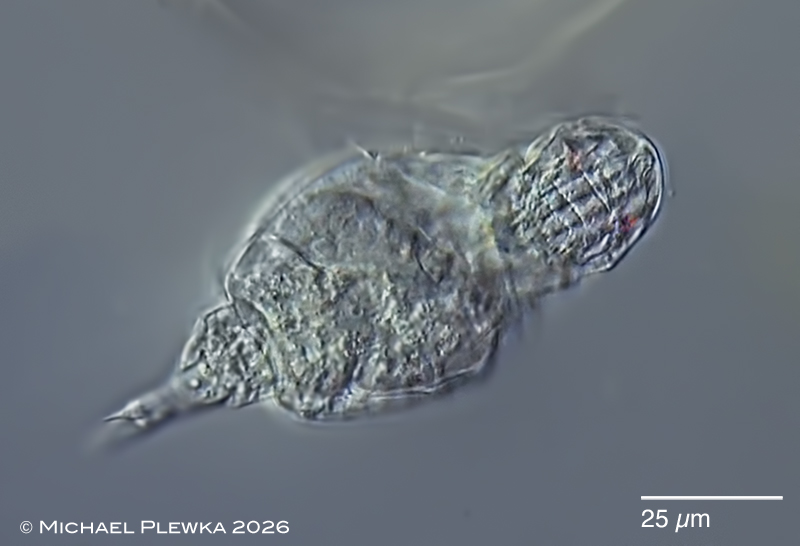 |
Squatinella longispinata, specimen from (5); dorsoventral view; focal plane on the ciliary field with metachronal waves and the dorsal spine on the foot. The specimens of sample (5) + (6) were found in running water (see below) .
Bilfinger (1894) observed Squatinella leydigi from running water, a species that is similar to S. longispinata, but has no dorsal spine on the foot according to Zacharias (1886). |
| |
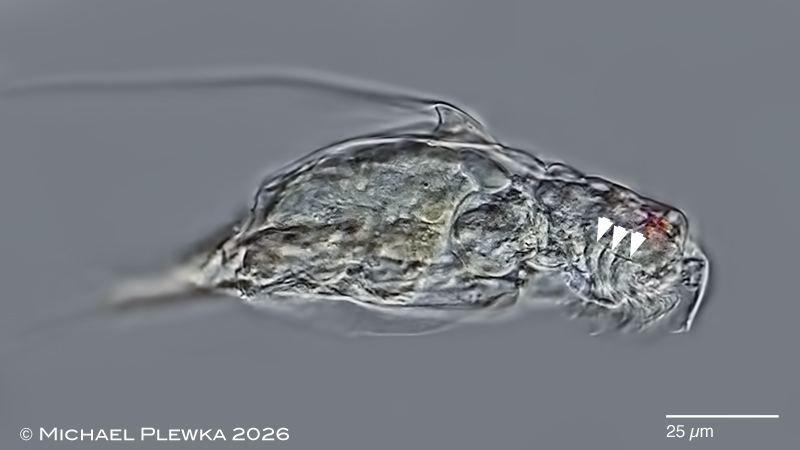 |
| Squatinella longispinata, specimen from (6); lateral view, optical sagittal transect. The arrowheads mark 3 bundles of cilia which originate from the 3 rows of hypodermis cells (see images above). |
| |
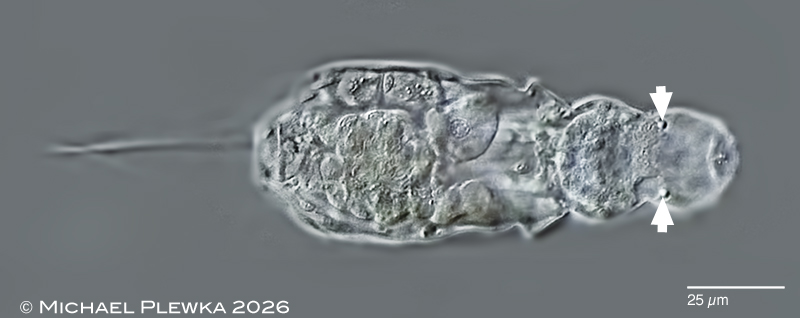 |
Squatinella longispinata, specimen from (6), dorsal view. The arrows point to 2 light-refracting bodies (not eyespots! |
| |
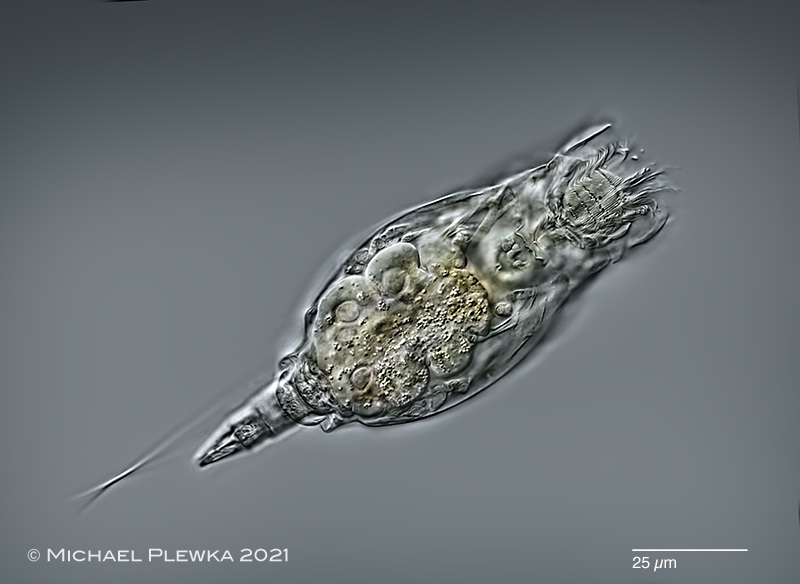 |
| Squatinella longispinata, ventral view, specimen from (4) |
| |
| Collection of sample (4) courtesy of Uli Drabiniok |
| |
| |
|
|
| |
| |
|
|
| |
| |
| Location : Nature reserve Heiliges Meer, Sphagnum/ Utricularia-pond (1, 2); nature reserve NSG Heiliges Meer, NRW, Germany, pond "Kleinweiher "Üffings Wiese" (location 16) (4); |
| Habitat: Periphyton (1, 2, 3); plankton with detritus, together with Lecane mira and Notommata cerberus (4) |
| Date: coll.: 4/2012; det. 26.10.2012 (1); coll. 2.11.2012; img: 19.6.2013 (2); 19.11.2021 (4) |
| |
| |